



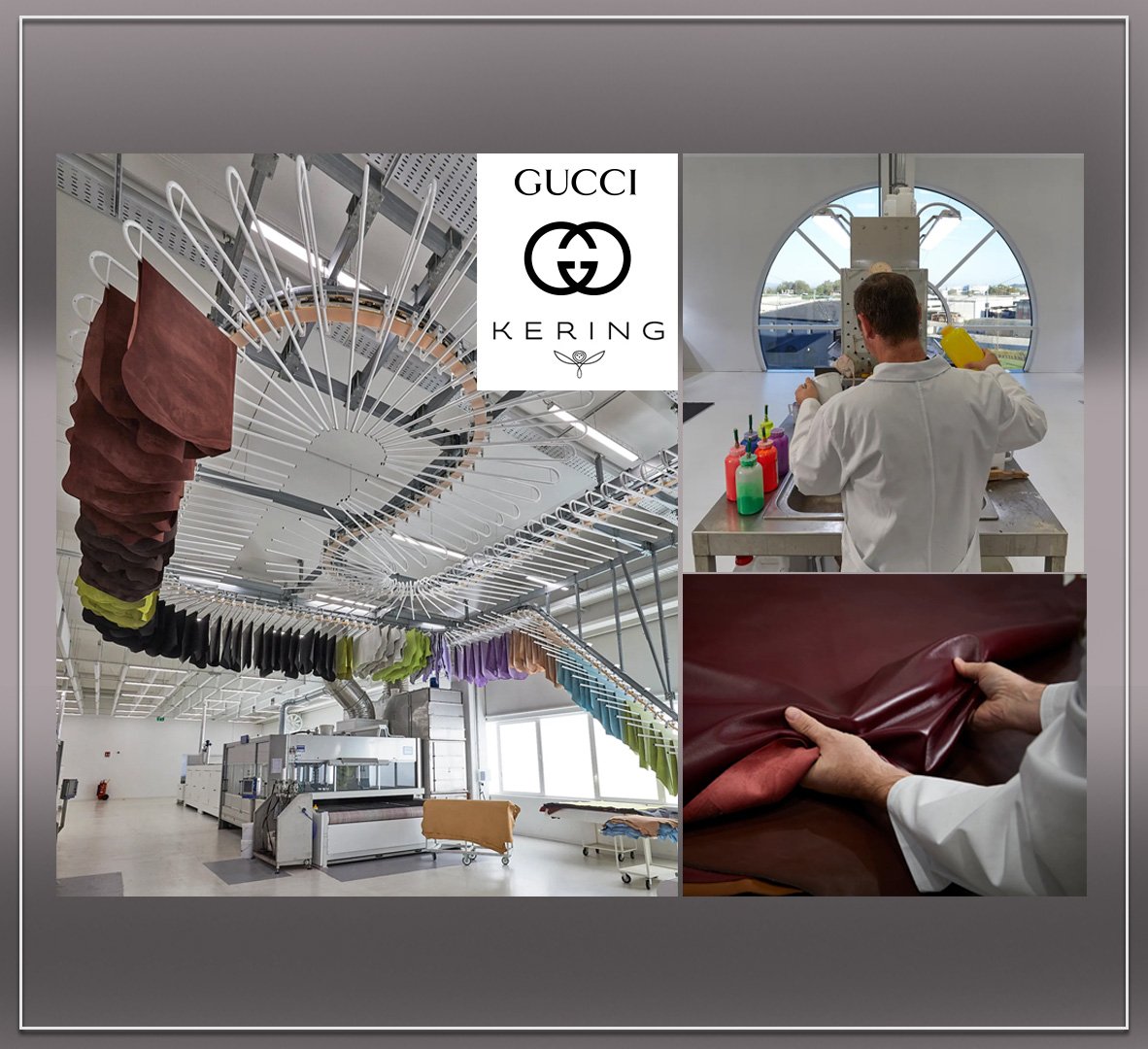
As materials account for the largest share of fashion’s carbon footprint, innovation in this area has become one of the industry’s most strategic battlegrounds. According to British Vogue, Gucci has taken a major step in this direction by opening a new research center in 2024 in San Miniato, Tuscany – one of the world’s historic leather-making hubs.
The facility was created to bring material innovation fully in-house.
“The center was created for the research, development and testing of all our innovative materials,” explains Marie-Claire Daveu, Chief Sustainability and Institutional Affairs Officer of Kering, Gucci’s parent company. “We need to combine sustainability with superior technical performance, so that every new material meets the luxury standards expected of Gucci.”
Over the past decade, many startups have attempted to develop alternatives to conventional leather – from mushroom-based materials to algae-derived fabrics – but scaling and quality challenges have caused many of them to fail. Gucci’s strategy is different: by owning the entire R&D process, the brand ensures that innovation matches both luxury and industrial requirements.


Leather at the heart of innovation
Leather remains a central focus of Gucci’s research, despite its high environmental footprint. The brand is working on both more sustainable methods of producing animal leather and on high-performance vegan alternatives.
“The ambition is to shape the tannery model of the future,” Daveu says. “One that can process leather and new materials, while being more efficient, more sustainable and more circular.”
Inside Gucci’s research lab, located within the Marbella tannery, hundreds of samples in multiple colours hang on conveyor belts while scientists test between 10 and 20 new materials at any one time. Finishing, dyeing, embossing and durability are analysed, while a high-tech climate chamber simulates tropical ageing conditions.
From Demetra to AI
One of the lab’s flagship innovations is Demetra, Gucci’s vegan leather alternative launched in 2021 and used in the Horsebit 1955 bags in 2023. Made from 75% plant-based raw materials, Demetra offers significantly lower carbon and water footprints than traditional leather.
At the same time, Gucci is reducing waste through its Scrap-Less programme. By cutting hides earlier in the process, leftover material can be converted into high-quality fertiliser. Artificial intelligence is also being used to detect defects in hides before production, helping prevent unnecessary waste.
Circularity across Kering
Alongside the lab, Gucci launched its Circular Hub in 2023 to drive sustainable practices across the entire Kering group. Projects include Denim Evolution, made from 74% regeneratively grown fibres, and an internal marketplace allowing deadstock fabrics to be reused by other Kering brands.
With Kering committed to cutting absolute emissions by 40% by 2035, Gucci’s innovations are being shared with Saint Laurent, Bottega Veneta, Balenciaga and Alexander McQueen – turning one brand’s lab into a group-wide transformation engine.